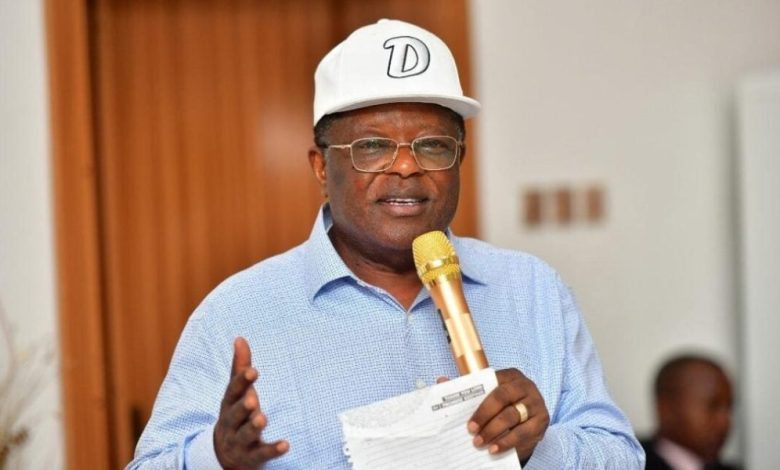
Minister of Works and former Ebonyi State Governor, David Umahi, has come under criticism following his recent comment that it is not yet the turn of the South-East to produce Nigeria’s president.
Umahi made the remarks on Thursday in Benin, Edo State, while speaking about the Federal Government’s infrastructure projects and defending President Bola Tinubu’s administration.
The minister was responding to discussions around the 2027 presidential election and the possibility of former Anambra State Governor Peter Obi challenging Tinubu.
Umahi said the South-East would eventually have an opportunity to produce the president but argued that the current political period belongs to Tinubu.
“What we are saying is that it’s not the turn of the Igbo yet,” Umahi said.
He added: “I want to be president, but it’s not yet our turn. It’s the turn of President Bola Tinubu.”
The minister said political opportunities would come for the South-East at the appropriate time, adding that “at the time of God, He makes all things beautiful.”
His comments have since generated reactions from political commentators and others who disagree with his position on the rotation of the presidency.
Critics argued that political power should not be treated as the personal property of any individual, while others maintained that the South-East has not occupied the presidency since the beginning of the Fourth Republic in 1999.
Umahi’s comments came shortly after he questioned claims that Obi was not his political match.
The minister said he was prompted to examine Obi’s record after hearing the comparison.
“When that guy said that Peter Obi is not my match, it took me 10 minutes to think about it,” Umahi said.
He questioned whether the comparison was based on family background, intellectual credentials, political achievements or records of service to the South-East.
He also asked whether Obi had performed better than him as a former governor, saying such comparisons should be based on specific achievements.
The minister further defended Tinubu’s administration against criticism, arguing that Federal Government infrastructure projects were benefiting communities across the country.
He called on supporters of the administration to highlight what he described as its achievements in the South-South, South-East and other parts of Nigeria.
“We are saying that the president has done very well. In South-South, in South-East and in the entire geopolitical zone, he deserves continuity, he deserves support,” Umahi said.
However, public affairs analyst Adedayo Oluwatosin criticised the minister’s position, arguing that Umahi was attempting to remain in Tinubu’s favour.
Oluwatosin said the argument that it was not yet the turn of the Igbo was inconsistent with the history of presidential power since 1999.
He pointed to former presidents Olusegun Obasanjo of the South-West and Goodluck Jonathan of the South-South, arguing that the South-East was yet to produce a president during the Fourth Republic.
He also challenged Umahi’s comparison of his record with that of Obi.
According to Oluwatosin, Obi’s supporters consider the former Anambra governor a leading candidate from the South-East and believe the region should have an opportunity to produce the president.
Another commentator, Lagos-based businessman Chidozie Okafor, also criticised Umahi’s position.
Okafor argued that the question of regional representation remains important in the 2027 political debate and claimed that many Nigerians who support Obi believe the South-East should be given the opportunity to produce the president.
He further claimed that Obi had gained support beyond the South-East and would benefit from voters who favour a candidate from the region.
Okafor also rejected Umahi’s argument that the minister and Obi should be compared solely on political records.
Other commentators similarly defended Obi while criticising Umahi.
Lagos-based lawyer Marcellus Onah described the criticism directed at Obi as evidence, in his view, of the former governor’s growing political profile.
Onah argued that Umahi’s position should not determine whether the South-East eventually produces a presidential candidate capable of securing national support.
James Okoye, another commentator quoted in the debate, also criticised Umahi for opposing calls for Obi’s candidacy.
Okoye argued that Obi’s political record should be the basis for evaluating his presidential ambition rather than the views of individual politicians.
He also questioned whether Umahi would be willing to subject his own record in public office to the same level of scrutiny that supporters of Obi demand for political candidates.
The reactions reflect a broader disagreement over the principle of zoning and rotational presidency ahead of the 2027 election.
Supporters of zoning have continued to argue that Nigeria’s political leadership should reflect regional balance, while other political actors have maintained that presidential elections should be determined primarily by voters rather than an informal rotation arrangement.
Umahi’s latest comments have therefore added another dimension to the ongoing debate within the South-East and across the country over the 2027 presidential contest.
While the minister has expressed support for Tinubu’s continuity and acknowledged his own presidential ambition, he also said he believes the South-East will have its opportunity in the future.
The debate is expected to continue as political parties and presidential contenders position themselves ahead of the 2027 election.If you want, I can also make this more punchy and Daily Post-style, with a stronger headline and tighter 40–60-word paragraphs.