
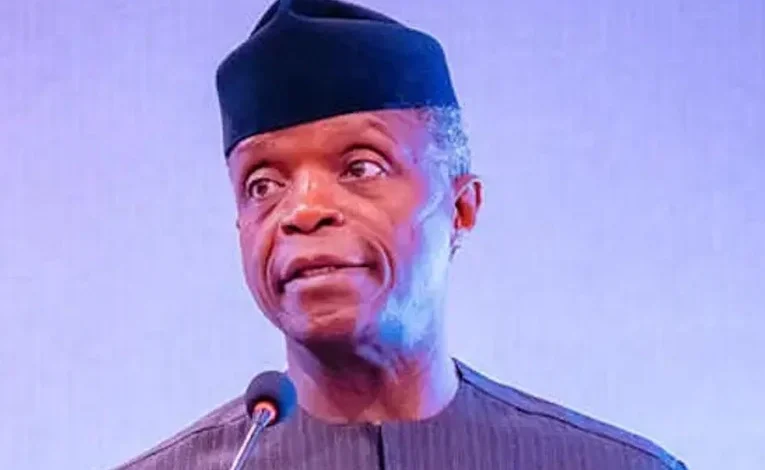
Former Vice President Yemi Osinbajo has urged African countries to reduce their dependence on foreign arbitration centres and strengthen local institutions to handle commercial disputes.
He said the continent must build credible dispute resolution systems capable of attracting international businesses instead of routinely exporting major commercial disputes to jurisdictions such as London, Paris, Geneva, Washington and Stockholm.
Osinbajo made the call while delivering the keynote address at the 2026 annual conference of the Nigerian Institute of Chartered Arbitrators (NICArb) in Lagos.
He was represented by former Lagos State Attorney-General and his former Chief of Staff, Ade Ipaye.
The conference was themed, Reimagining Arbitration and ADR in Africa: Innovation, Integrity, and Commercial Justice in a Changing World.
According to Osinbajo, Africa’s historical reliance on foreign jurisdictions for disputes involving oil and gas, mining, infrastructure and telecommunications has allowed foreign institutions to shape much of the continent’s commercial arbitration jurisprudence.
“For much of the last century, arbitration in Africa was largely something that happened to us rather than by us. Our disputes, especially the big ones in oil and gas, mining, infrastructure and telecommunications, were exported to London, Paris, Geneva, Washington and Stockholm,” he said.
He acknowledged progress in Africa’s arbitration landscape, particularly Nigeria’s Arbitration and Mediation Act 2023, which introduced provisions covering third-party funding, emergency arbitrators, consolidation of proceedings and mediation.
He also identified Lagos, Kigali, Cairo, Mauritius, Nairobi and Johannesburg as emerging arbitration destinations seeking greater international recognition.
Osinbajo identifies three pillars for African arbitration
The former Vice-President identified innovation, integrity and commercial justice as three essential pillars for strengthening arbitration and alternative dispute resolution across Africa.
On innovation, he argued that dispute resolution should be treated as critical economic infrastructure, alongside electricity, ports and broadband.
He explained that investors consider the time and cost of enforcing commercial contracts when deciding where to invest.
Osinbajo advocated wider adoption of technology, including virtual hearings, electronic documentation, real-time transcription and remote examination of witnesses, to reduce arbitration costs and delays.
He also supported the responsible use of artificial intelligence in document reviews, evidence summaries and legal research.
However, he warned against allowing AI to replace the independent judgment of arbitrators.
“Parties appoint a human being for his or her judgment, and that judgment cannot be delegated to an algorithm,” he said.
He urged arbitration institutions to establish guidelines governing AI deployment, disclosure and accountability.
Osinbajo recalls Nigeria’s $11bn P&ID dispute
Addressing professional integrity, Osinbajo cited Nigeria’s controversial $11bn arbitration dispute with Process and Industrial Developments (P&ID) as a warning about corruption and misconduct.
He recalled that a London commercial court set aside the arbitration award against Nigeria in October 2023 after finding that it had been obtained through fraud, including bribery and the improper use of privileged Nigerian government legal documents.
“The integrity of arbitration was not protected by the process; it was rescued at great cost despite the process,” he said.
Osinbajo called for stricter disclosure requirements concerning arbitrators’ relationships, repeat appointments and potential conflicts of interest, including those involving third-party funders.
He also urged African governments to strengthen their capacity to defend arbitration claims involving public contracts.
Additionally, he called on African courts to respect party autonomy, avoid unnecessary interference in arbitration proceedings and enforce awards promptly, while intervening where there is evidence of fraud or corruption.
AfCFTA needs affordable dispute resolution, says Osinbajo
On commercial justice, Osinbajo maintained that arbitration must become affordable and accessible to small and medium-sized businesses rather than remain largely the preserve of big corporations and governments.
He noted that the African Continental Free Trade Area (AfCFTA), which provides for a single market of more than 1.3 billion people, requires dependable mechanisms for resolving cross-border commercial disputes.
“If a Nigerian supplier cannot enforce a contract against a Liberian buyer quickly and affordably, the free trade area exists on paper, but not in the ledger where it matters,” he said.
He advocated affordable arbitration fees, expedited procedures, online dispute resolution, effective enforcement mechanisms and wider adoption of the Singapore Convention on Mediation.
NBA president backs Nigerian arbitrators
Also speaking at the conference, Nigerian Bar Association (NBA) President Oyinkansola Badejo-Okusanya, SAN, urged the Federal Government and businesses to give Nigerian arbitrators greater opportunities to handle commercial disputes.
She maintained that Nigeria possessed the expertise and institutions to compete internationally, urging stakeholders to demonstrate greater confidence in local professionals.
“We are 60 plus years post-colonial times. We should stop using foreign arbitrators when others don’t know it more than we do, and appoint Nigerian arbitrators,” she said.
Badejo-Okusanya also encouraged Nigerian arbitration institutions to publicise their achievements, including cases handled, duration and costs of proceedings, and outcomes of court challenges to arbitration awards.
“Our institutions in Nigeria do more work than the world knows. So let us show it. Let’s showcase ourselves. Let’s blow our trumpets,” she said.
She cautioned lawyers against abusing court proceedings to frustrate arbitration and called for mentorship and practical training opportunities for younger practitioners.
Meanwhile, NICArb President Omoruyi Omonuwa, SAN, urged African countries to move beyond being users of international arbitration and become trusted destinations for commercial dispute resolution.
He identified innovation, integrity, inclusion, capacity building and stronger judicial partnerships as priorities for improving arbitration across the continent.
Lagos State Governor Babajide Sanwo-Olu, represented by Attorney-General and Commissioner for Justice Lawal Pedro, SAN, also reaffirmed his administration’s commitment to institutions promoting commercial justice and investor confidence.
The conference further featured calls for stronger judicial capacity, responsible technology adoption and practical measures to make arbitration faster, more affordable and accessible to businesses.