
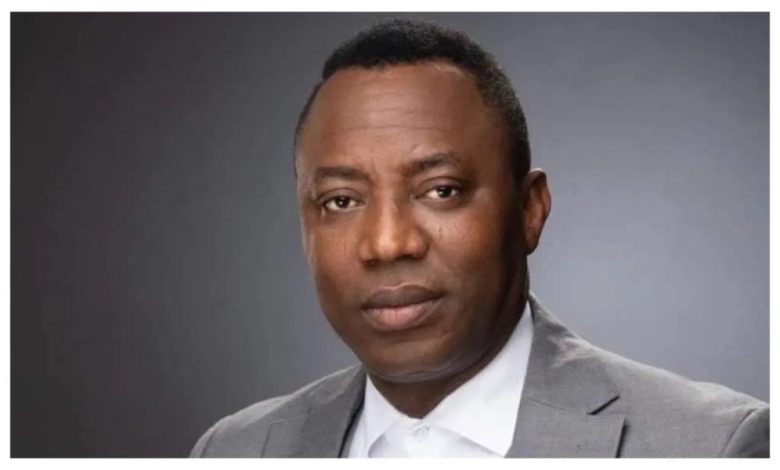
African Action Congress (AAC) presidential candidate for the 2027 general elections, Omoyele Sowore, has said Nigerians should not be arrested or prosecuted simply for criticising President Bola Tinubu or calling him names.
Sowore made the comment on Monday during an interview on Arise Television’s Prime Time, where he discussed freedom of expression and the treatment of critics under a democratic government.
The AAC candidate argued that citizens have the right to express their views about public officials, including the president, even when such comments are harsh or unflattering.
According to him, criticism of the president does not automatically amount to a criminal offence.
“Criticising or calling President Tinubu names does not constitute an offence,” Sowore said during the interview.
He argued that security agencies should not be used to intimidate citizens because of opinions expressed against the government or its officials.
Sowore said that if he were president and learnt that an intelligence officer had arrested someone solely for criticising or insulting him, he would take action against the officer.
“If I were to be President and I heard someone had been arrested for criticising or calling me names, I would fire the intelligence officer because it means that the intelligence officer is not intelligent,” he said.
The activist also referred to previous comments attributed to Tinubu concerning the arrest or prosecution of people who criticise him.
Sowore said Tinubu had, on several occasions, indicated that he did not want people arrested simply for calling him names.
“In fact, to be fair to Tinubu, and I want to say this for the first time, he has said it several times that he doesn’t want anybody arrested or prosecuted for calling him any name,” Sowore said.
He suggested that Tinubu understood the implications of restricting political speech because the president had himself engaged in name-calling during political contests.
“He knew why he said that. He used to do name-calling too. He’s called President dead meat. He’s called people all kinds of names,” Sowore added.
The AAC candidate maintained that freedom of expression is an important part of democratic governance.
According to him, citizens should be able to speak their minds about political leaders without automatically being treated as criminals.
“He knows that under a democratic system of government, you are not supposed to go after people because they are speaking their minds,” he said.
Sowore’s comments come amid continuing debates in Nigeria over the limits of political criticism, freedom of expression and the use of law enforcement powers in cases involving statements made against public officials.
The issue has also featured in legal proceedings involving Sowore himself. A court recently fixed October 2 for him to continue his defence in a case concerning alleged cyberbullying of President Tinubu.
The development has placed renewed attention on the distinction between political criticism and statements that may fall within existing criminal or cyber-related laws.
While Sowore framed the issue around citizens’ democratic rights, the legal question in any individual case depends on the specific allegation, the applicable law and the facts presented before the court.
The disagreement over how political speech should be treated is particularly relevant ahead of the 2027 general elections, when candidates, political parties and supporters are expected to engage in vigorous campaigns and public debate.
Nigeria’s electoral environment routinely features strong criticism of political leaders, especially on social media and other digital platforms. Campaign messages, interviews and online commentary can reach large audiences within minutes, increasing the significance of debates surrounding responsible political expression.
Sowore, who has been a prominent critic of successive Nigerian governments, has continued to position freedom of expression and accountability among the issues central to his political advocacy.
His latest remarks focused on the principle that disagreement with a president should not, by itself, be treated as criminal conduct.
He also appeared to distinguish between offensive political language and actions that may independently violate the law.
The comments are likely to remain part of the broader public discussion as political activities ahead of the 2027 elections intensify and competing parties seek to define their positions on governance, civil liberties and accountability.
For Sowore, however, the central argument is that occupying the highest political office should not remove a public official from public criticism.
He maintained that citizens in a democracy should retain the freedom to express their views about those who govern them, including strong or unpopular opinions, within the boundaries established by law.