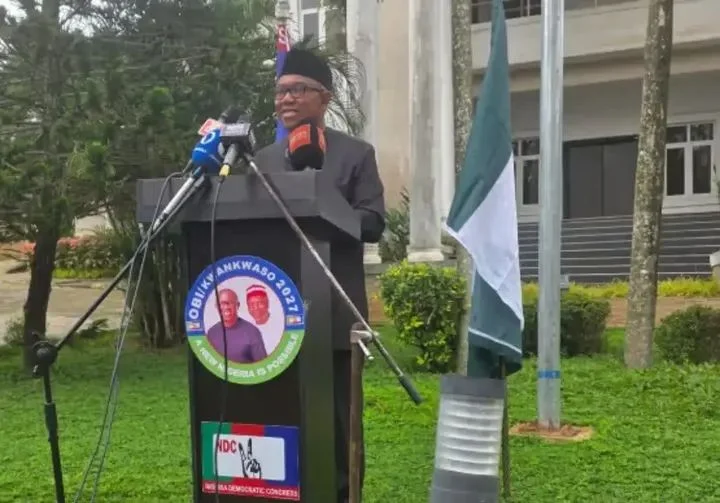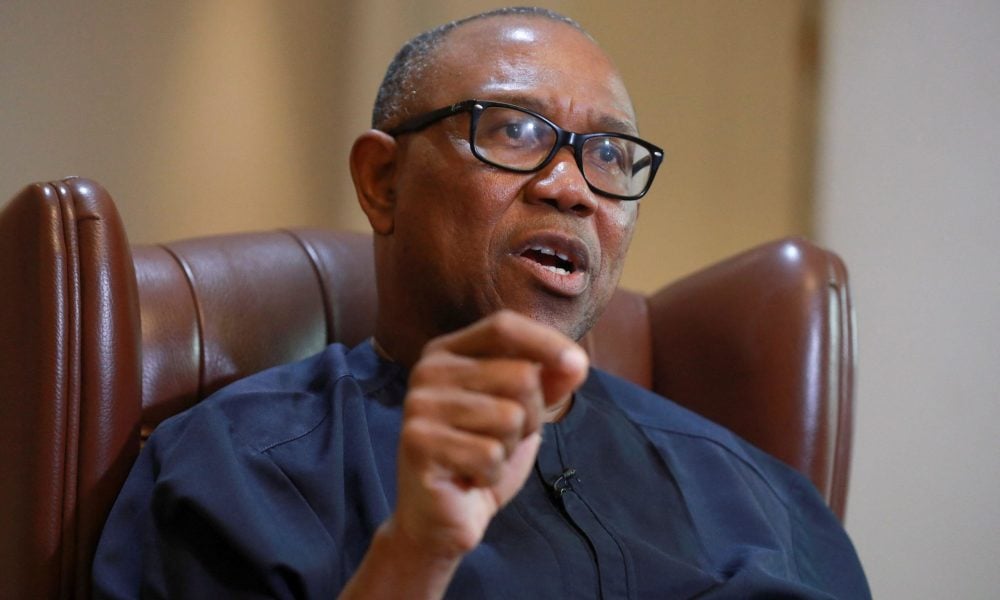
Former Anambra State Governor Peter Obi has denied borrowing money from banks or other financial institutions during his eight years in office, amid an ongoing dispute over the state’s finances.
Obi, who is the presidential candidate of the Nigeria Democratic Congress (NDC), made the clarification while appearing on Arise Television’s Prime Time programme on Thursday night.
His comments come against the backdrop of a public disagreement with the current Anambra State Governor, Chukwuma Soludo, over claims relating to debts, gratuities and other financial obligations allegedly inherited by successive administrations.
Obi maintained that his administration did not obtain bank loans or issue bonds to finance the affairs of the state during his tenure.
He said he never approached any financial institution to secure borrowing on behalf of Anambra State throughout the eight years he was in government.
“Let me categorically say again, I, Mr Peter Obi, didn’t approach any financial institution to borrow money or issue bonds on behalf of Anambra State in the eight years I was in government,” he said.
The former governor also rejected claims that his administration left unpaid salaries, pensions or gratuities that had already become due when he handed over power.
According to Obi, all salaries that were scheduled for payment had been settled by the time he left office.
He further said workers who were entitled to gratuities and pensions did not have outstanding payments due from his administration when he handed over.
“On the day I left office, I was not owing any salary, gratuity or pension that was scheduled to be paid by the government,” Obi said.
He also addressed concerns surrounding payments to contractors and suppliers who had completed government projects.
The former governor claimed that his administration did not leave unpaid bills owed to contractors or suppliers whose work had been completed, certified and verified.
“We are not owing any contractor or supplier who has executed his job, certified and verified, not one. And that is the way I left,” he said.
Dispute over Anambra finances
The latest comments are part of a wider dispute over the financial position of Anambra State and the responsibilities inherited by different administrations.
Obi governed Anambra State from 2006 to 2013, serving two terms after initially assuming office following a court ruling. He was succeeded by Willie Obiano, who governed the state for eight years before handing over to Soludo in 2022.
Questions about the state’s financial obligations have periodically featured in political discussions involving the different administrations.
Soludo has previously made claims about the financial commitments inherited by his administration, while Obi has repeatedly defended his record in office.
The disagreement has also become part of broader political exchanges as Nigeria approaches the 2027 general elections.
Obi, who previously contested the 2023 presidential election, is seeking the presidency again under the NDC.
His supporters have continued to point to his record in Anambra as part of the argument for his political platform, while his critics have questioned aspects of his administration’s financial record and governance.
Obi maintains position
The former governor’s latest statement places emphasis on his distinction between borrowing and other forms of financial obligations that a state government may have.
By specifically stating that he did not approach financial institutions to borrow money or issue bonds, Obi presented his position as a direct response to questions over whether his administration accumulated bank debt during his tenure.
He also broadened his response beyond loans by insisting that salaries, gratuities, pensions and verified contractor payments were not outstanding when he left office.
The claims are likely to remain part of the debate over the financial record of past Anambra administrations, particularly as political parties and their candidates prepare for the 2027 elections.
Obi’s statement, however, represents his account of the state’s financial position at the point he left office. Any assessment of outstanding liabilities would depend on the relevant government financial records, including audited accounts, debt records, payment schedules and documentation covering contracts and other obligations.
For now, the former governor has maintained that he left office without borrowing from financial institutions on behalf of Anambra State and without unpaid salaries, scheduled gratuities or pensions, or verified bills owed to contractors and suppliers who had completed their work.