
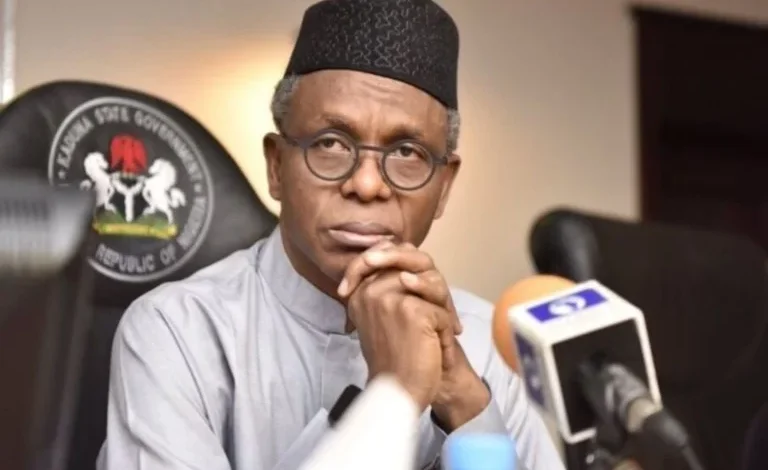
Former Kaduna State Governor Nasir El-Rufai has denied intercepting the telephone conversations of National Security Adviser (NSA) Nuhu Ribadu or directing anyone to do so, describing his earlier claim as political rhetoric.
El-Rufai made the clarification on Wednesday, November 25, 2026, while testifying in his defence before the Federal High Court in Abuja in his ongoing phone-tapping trial.
Led in evidence by his lawyer, Paul Erokoro, a Senior Advocate of Nigeria (SAN), the former governor told the court that he had never owned equipment used to intercept telephone conversations.
He also denied having the technical knowledge required to tap telephone calls or access to Ribadu’s communication networks and devices.
Explaining his controversial remarks during an interview with Arise Television in February, El-Rufai said he used the word ‘tapped’ as an exaggeration rather than a literal admission of phone interception.
“I used ‘we’ to refer to opposition politicians. When I said ‘tapped’, it was an embellishment intended to make the government feel the pain we are feeling. It was rhetorical and exaggerated. My objective was to engage in political retort and linguistic flourish,” he told the court.
How the Phone-Tapping Controversy Started
The case followed an interview El-Rufai granted Arise Television on February 13, 2026, during which he alleged that Ribadu ordered security operatives to arrest him following his return from Cairo, Egypt.
The former governor claimed he knew about the alleged directive because someone had intercepted the NSA’s telephone conversation and relayed the information to him.
During the interview, he said: “The government thinks that they’re the only ones that listen to calls… Someone tapped his phone.”
He also acknowledged that intercepting telephone conversations without authorisation was illegal.
Following the interview, the Department of State Services (DSS) instituted criminal proceedings against him over the alleged unlawful interception of Ribadu’s telephone communications.
The initial three-count charge was subsequently amended to five counts, including allegations relating to unlawful interception and the use of technical systems to compromise national security.
El-Rufai pleaded not guilty to all five counts.
El-Rufai Begins Defence After Court Rejects No-Case Submission
The former governor began presenting his defence after Justice Joyce Abdulmalik dismissed his no-case submission on October 26, ruling that the prosecution had presented sufficient evidence for him to answer the allegations.
The prosecution had earlier called two witnesses before closing its case.
El-Rufai has maintained that he did not intercept Ribadu’s telephone conversations, insisting that his controversial remarks were intended as political criticism of the Federal Government.
The court adjourned the case until February 15 and 16, 2027, for the continuation of his defence.