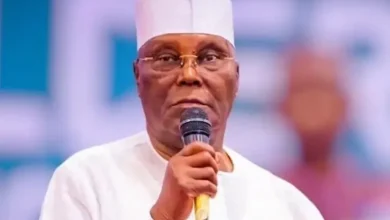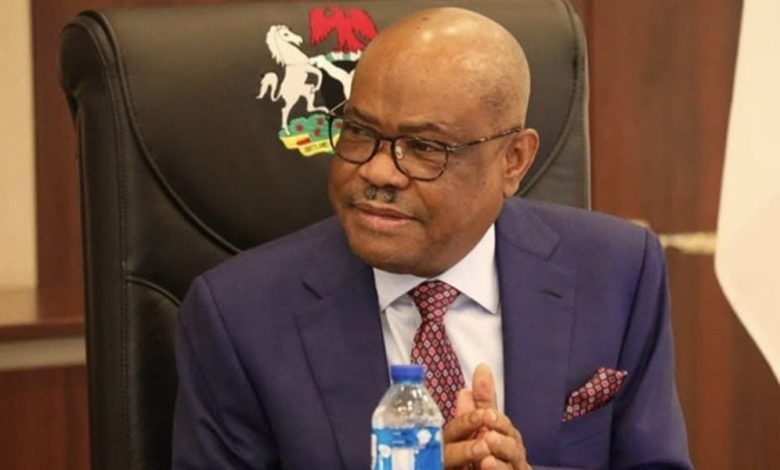
Minister of the Federal Capital Territory, Nyesom Wike, has explained the strategy adopted by the five governors who formed the G5 during the 2023 presidential election, saying their aim was to reduce the votes of former Vice President Atiku Abubakar rather than manipulate the election in favour of President Bola Tinubu.
Wike made the clarification on Wednesday while speaking with journalists in Abuja.
His comments followed controversy over remarks he previously made during an appearance on TVC’s Journalists’ Hangout, where he discussed the political calculations of the G5 governors during the 2023 presidential election.
The former Rivers State governor said the strategy was misunderstood by some opposition politicians and commentators, who interpreted his remarks as an admission that the election results had been manipulated to favour Tinubu.
Wike rejected that interpretation.
According to him, the G5’s political calculation was focused on limiting Atiku’s influence in parts of the South-South, particularly by encouraging voters who were likely to support the Peoples Democratic Party candidate to instead vote for Labour Party’s Peter Obi.
Wike rejects claim that he rigged election
Wike dismissed allegations that he personally altered election results in Rivers State or other parts of the South-South to help Tinubu.
He questioned how an individual could manipulate results from thousands of polling units across the country.
“People who don’t understand, how can they say I rigged the election? How would I have done it? So, I just took the result sheets, wrote it, and gave it to INEC?” he asked.
The minister said the allegation did not reflect how elections are conducted across a large number of polling units.
His comments came amid continuing political arguments over the outcome of the 2023 presidential election and the role played by politicians who opposed Atiku’s candidacy.
Wike was one of five then-serving governors who formed the G5 within the PDP ahead of the election.
The group had demanded changes within the party and opposed the decision to field Atiku as the presidential candidate while former governor of Anambra State, Peter Obi, contested the election on the Labour Party platform.
G5 wanted to reduce Atiku’s votes
Wike said the governors believed Atiku posed a greater political challenge to their interests in the election than Obi.
He explained that their strategy was therefore to encourage voters to support Obi in areas where doing so could reduce the number of votes available to Atiku.
“We felt that Atiku was more of a factor in that election than Obi. So our strategy was that, make sure that you vote for Obi to win in order to deny Atiku the votes,” Wike said.
He maintained that the strategy achieved its intended political objective.
The remarks provide Wike’s account of the G5’s approach to the 2023 presidential contest, although they do not establish that election results were altered.
The 2023 presidential election was contested by several major candidates, with Tinubu of the All Progressives Congress eventually declared winner by the Independent National Electoral Commission.
Atiku contested the result in court, while Obi also challenged the outcome.
Wike dismisses social media election claims
The FCT minister also criticised the use of social media trends as evidence for determining the outcome of nationwide elections.
He argued that online discussions could not accurately represent voting patterns across the country because Nigeria has a large number of polling units and voters.
“I’ve always said social media does not win elections,” Wike said.
He noted that there were about 176,000 polling units and questioned how anyone could draw a conclusion about the national result after observing results or discussions from only a small number of polling units.
“You have about 176,000 polling units, and probably you have seen 300 polling units and then you rush to the conclusion that so-and-so has won,” he said.
His comments highlighted the difference between online political discussions and the official process used to collate election results.
Opposition failed to prove manipulation, Wike says
Wike also referred to the legal challenges that followed the 2023 presidential election.
He said opposition politicians had failed to prove in court that results from Rivers State had been manipulated.
The minister therefore maintained that allegations concerning the election should be assessed against the actual results and evidence presented during legal proceedings rather than social media narratives.
The controversy over the 2023 election remains part of Nigeria’s wider political debate as parties and politicians prepare for the 2027 general elections.
Wike’s latest explanation also places renewed attention on the political role of the G5 governors and their decision to oppose Atiku within the PDP before the 2023 presidential contest.
The group had argued that internal party arrangements needed to change before they could support the party’s presidential campaign.
Their decision not to fully back Atiku contributed to the political realignment that took place before the election, with the five governors pursuing positions that differed from the official PDP campaign.
Wike has continued to defend those decisions while serving as a minister in President Tinubu’s administration.
His latest comments, however, distinguish between political campaigning against a candidate and direct manipulation of election results.
He said the G5’s approach was to influence voters and weaken Atiku’s support by encouraging some voters to back Obi.
Wike also insisted that claims of rigging should not be based solely on political arguments or online reactions.
According to him, the focus should remain on the results recorded at polling units and the evidence presented through the formal electoral and judicial processes.
As Nigeria moves towards the 2027 election cycle, his comments are likely to keep the G5’s role in the 2023 presidential election in focus, particularly its decision to oppose the PDP’s presidential candidate and pursue an alternative political strategy.